How to Read a Lash Serum Ingredient List: A Pharmacist’s Guide
Turn over almost any lash serum and you will find a list of ingredients that looks more like a chemistry exam than something designed to help you choose a beauty product.
Aqua. Peptides. Botanical extracts. Humectants. Preservatives. Long ingredient names you may never have seen before.
So how do you actually tell whether a lash serum has been thoughtfully formulated?
The answer is not to search every unfamiliar ingredient on TikTok.
It is to understand how cosmetic ingredient lists work.
At Nuur Cosmetics, we believe women should understand what they are applying so close to their eyes. Nuur was founded by healthcare professionals, and our Clinical Director, Esa Badr, is a clinical pharmacist with more than 10 years of healthcare experience.
This guide explains how to read a lash serum ingredient list properly, what ingredient order actually tells you, what it does not tell you, and why the finished formulation matters more than any single fashionable ingredient.
First: what is an INCI list?
INCI stands for International Nomenclature of Cosmetic Ingredients.
It is the standardised naming system used to identify ingredients in cosmetic products.
That is why the same ingredient may appear under a name that looks very different from the wording used in advertising.
For example:
Hyaluronic acid may appear as Sodium Hyaluronate.
Vitamin E may appear as Tocopherol.
Vitamin B5 may appear as Panthenol.
Botanical ingredients often appear under their scientific plant names.
This standardisation gives consumers, formulators, safety assessors and regulators a common language for identifying cosmetic ingredients.
In Great Britain, cosmetic products are required to display a full ingredient list using recognised cosmetic ingredient names. (gov.uk)
Does the order of ingredients tell you the concentration?
Partly.
But this is one of the most misunderstood parts of cosmetic ingredient lists.
Under UK cosmetic rules, ingredients are generally listed in descending order by weight at the point they are added to the product. (gov.uk)
So, broadly speaking, ingredients near the beginning of a formula are present in greater amounts than ingredients further down.
However, there is an important exception.
Ingredients present at concentrations below 1% may be listed in any order after ingredients present at 1% or above.
That means an INCI list is not a concentration chart.
If Ingredient A appears immediately before Ingredient B, you cannot automatically calculate how much of either is present.
And you should not assume that an ingredient near the bottom of a list is irrelevant.
Some cosmetic ingredients are intentionally used at relatively low concentrations.
The useful question is not simply:
“How high up the list is it?”
It is:
“Is it being used appropriately within the finished formulation?”
Why water being the first ingredient is not a bad thing
You will often see Aqua, or water, near the beginning of a serum ingredient list.
Occasionally this gets portrayed online as evidence that a product is somehow “mostly water” and therefore poor value.
That misunderstands formulation.
Water is one of the most common bases for cosmetic serums because it acts as a solvent in which other ingredients can be incorporated.
What matters is what has been built into that base.
A water-based serum can contain carefully selected peptides, humectants, conditioning ingredients, botanical extracts and other components designed to work together.
Judging a serum simply because Aqua appears first tells you very little about its overall quality.
Why one hero ingredient does not make a good lash serum
Beauty marketing loves a hero ingredient.
Peptides.
Biotin.
Hyaluronic acid.
Ginseng.
Pumpkin seed extract.
And there is nothing inherently wrong with highlighting interesting ingredients.
The problem begins when consumers are encouraged to judge an entire formula based on one of them.
A finished cosmetic is a system.
A formulator must consider:
- how ingredients interact
- their concentrations
- solubility
- stability
- pH
- preservation
- compatibility
- intended use
- packaging
- exposure
- overall tolerability
Two serums could feature several of the same ingredients on their labels and still be meaningfully different products.
The ingredient list is important.
But the ingredient list is not the whole formulation.
What do peptides mean in a lash serum?
Peptides are short chains of amino acids.
They are widely used throughout modern cosmetic science, including skincare, haircare and lash formulations.
But the word “peptide” describes a broad family rather than one single ingredient.
Different peptides have different structures and cosmetic functions.
This is why simply advertising a product as a “peptide serum” does not tell you very much.
You should ask:
Which peptides?
How many?
What role do they play within the formula?
What else surrounds them?
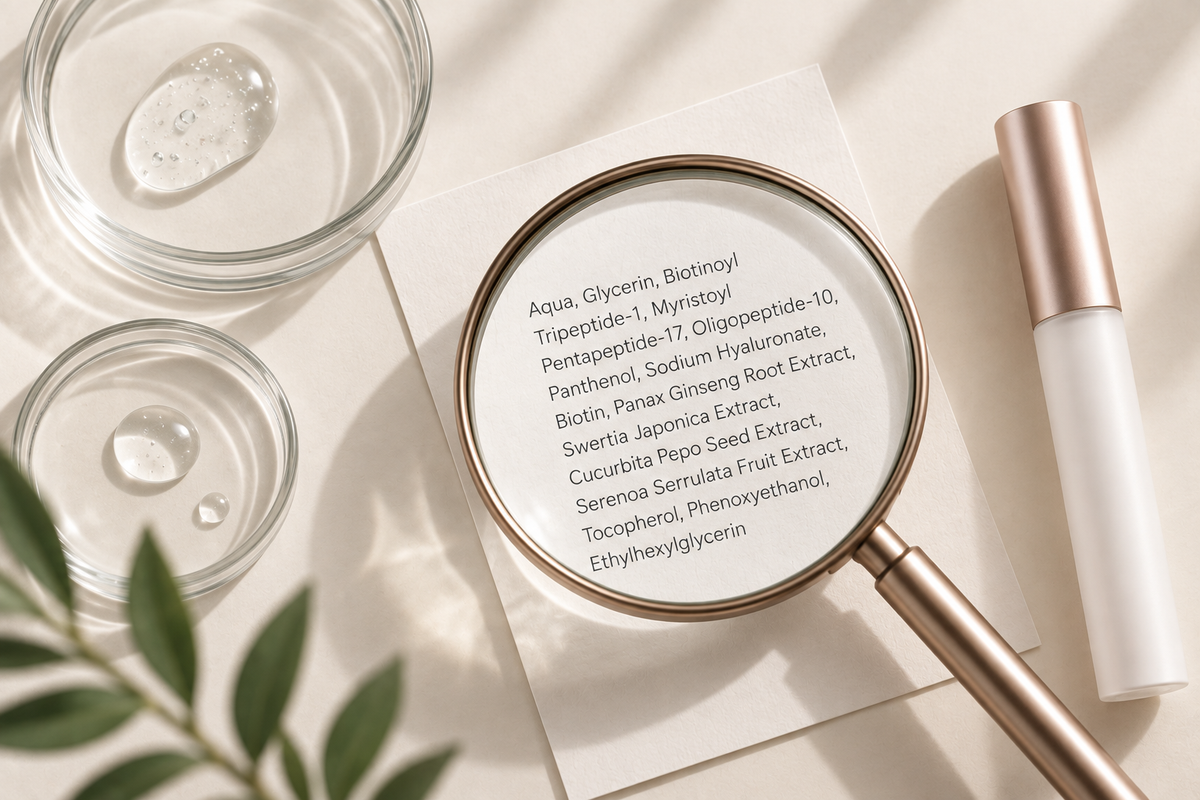
Nuur Lash contains three named peptides:
- Biotinoyl Tripeptide-1
- Myristoyl Pentapeptide-17
- Oligopeptide-10
That is why we describe Nuur Lash as a multi-peptide formula rather than simply putting the word “peptide” on the front and leaving the explanation there.
What about biotin?
Biotin, also known as vitamin B7, is another ingredient commonly associated with hair and lash products.
But there is an important distinction between topical cosmetic formulation and nutritional deficiency.
Biotin is an essential nutrient, and genuine biotin deficiency can affect hair and other tissues.
That does not mean adding biotin to every cosmetic automatically causes dramatic growth.
Within cosmetics, ingredients need to be considered according to the role they perform in that particular formulation.
Nuur Lash contains biotin as part of its wider multi-ingredient formula.
That is a more responsible way to discuss it than implying that one vitamin alone is responsible for every result.
What are humectants?
Humectants are ingredients that help attract and retain water.
They are extremely common in skincare and other cosmetic products because hydration can affect how skin and hair fibres look and feel.
Examples include glycerin and sodium hyaluronate.
Nuur Lash contains both.
This is useful because good lash care is not only about maximum length.
Condition, flexibility and the appearance of healthy lashes matter too.
What are conditioning ingredients?
The term “conditioning” can sound less exciting than “growth”.
But it matters.
Eyelashes are hair fibres.
Repeated mascara use, curling, rubbing, makeup removal and environmental exposure can affect how those fibres look and feel.
Conditioning ingredients can help support a formula designed around healthier-looking lashes.
Panthenol is one example.
Nuur Lash contains panthenol, alongside ingredients such as tocopherol and several botanical extracts.
Again, the point is not that one of these ingredients single-handedly creates the result.
It is how they contribute to the finished formulation.
What do botanical extracts actually tell you?
Botanical extracts are popular in modern cosmetics.
Nuur Lash includes ingredients such as:
- Panax Ginseng Root Extract
- Swertia Japonica Extract
- Cucurbita Pepo, or pumpkin seed, extract
- Serenoa Serrulata fruit extract
They can contribute different cosmetic functions within a formulation.
But “plant-based” should never be treated as synonymous with “better”, “safer” or “more effective”.
Natural ingredients are chemicals too.
Some natural substances are highly active.
Some synthetic substances are exceptionally well tolerated.
A good formulation should be judged by evidence, suitability and safety rather than whether the ingredient name sounds natural.
What about preservatives?
Preservatives have acquired an unnecessarily bad reputation online.
But preservation is an important part of cosmetic science.
Cosmetics can contain water and other ingredients capable of supporting microbial contamination if the formulation is not appropriately protected.
A preservative helps protect a cosmetic product against microbial growth during its usable life.
That is especially relevant to something repeatedly opened and used around the eye area.
The presence of a preservative should therefore not automatically be treated as a negative.
The better question is whether the overall preservation system has been appropriately formulated and safety assessed.
“Preservative-free” is not automatically safer.
Neither is “natural”.
Cosmetic science is more nuanced than that.
Can you tell whether a lash serum will work just from the ingredient list?
No.
And this is probably the most important point in this guide.
An INCI list can tell you what ingredients are present.
It cannot tell you everything about:
- exact concentrations
- formulation technique
- ingredient quality
- stability
- manufacturing quality
- finished-product tolerability
- finished-product performance
This is why copying another brand's ingredient list does not necessarily recreate its product.
The formulation itself matters.
Testing matters.
Manufacturing matters.
Evidence matters.
Ingredient evidence is not automatically product evidence
Suppose an individual ingredient has been studied and shown to have a particular property.
That does not automatically prove that every finished cosmetic containing that ingredient produces the same outcome.
Concentration may differ.
The delivery system may differ.
The formulation surrounding the ingredient may differ.
The population studied may differ.
The endpoint measured may differ.
UK cosmetic regulation reflects this principle.
Where a cosmetic makes a claim, the supporting evidence should be appropriate to the nature and effect of that claim. (gov.uk)
This distinction between ingredient evidence and finished-product evidence is one of the most important concepts in responsible cosmetic marketing.
What is a CPSR and why does it matter?
Reading an ingredient list is something a consumer can do.
Assessing whether a complete cosmetic formulation is safe is a different process.
Before a cosmetic product is placed on the Great Britain market, the Responsible Person must ensure that a safety assessment has been completed.
This takes the form of a Cosmetic Product Safety Report, usually shortened to CPSR.
A CPSR considers much more than whether individual ingredients sound familiar.
It can include assessment of:
- quantitative and qualitative composition
- physical and chemical characteristics
- stability
- microbial quality
- impurities
- packaging
- normal and reasonably foreseeable use
- exposure to the product
- toxicological profiles
- undesirable effects
- other relevant product information
UK government guidance explains the requirements for cosmetic safety assessment in Great Britain. (gov.uk)
Nuur Lash has undergone an independent Cosmetic Product Safety Report.
That is very different from simply looking at an ingredient list and deciding that the ingredients “look safe”.
Cosmetic safety assessment and ophthalmological testing are different
These terms are sometimes confused.
A cosmetic safety assessment evaluates the safety of the complete formulation when used as intended.
Ophthalmological testing provides additional information about how a finished eye-area product is tolerated by people under defined test conditions.
Nuur Lash has undergone both independent cosmetic safety assessment and ophthalmological testing.
In its four-week ophthalmological application study, no moderate or severe signs were recorded in the measured eye-area categories.
A small number of participants experienced slight eye-area irritation.
This is important context because no cosmetic can guarantee that every person will tolerate it identically.
The purpose of testing is to gather evidence about the finished product rather than assuming tolerability from an ingredient list alone.
So how would a pharmacist read the Nuur Lash ingredient list?
Not by searching for one miracle ingredient.
We would look at the formula in layers.
First, the base of the formula.
Then the multi-peptide system.
Then the hydrating and conditioning ingredients.
Then the botanical components.
Then the preservation system.
Then the finished-product safety assessment.
Then any additional finished-product testing.
That gives a much more useful picture than simply asking:
“Does it contain peptides?”
Nuur Lash contains a multi-peptide system alongside biotin, panthenol, sodium hyaluronate, glycerin, tocopherol and selected botanical extracts.
It is prostaglandin-free and was formulated in the UK with a clinically informed approach.
It has also undergone independent cosmetic safety assessment and ophthalmological testing.
Those facts together tell you far more about the product than one headline ingredient could.
Red flags when reading lash serum marketing
There are a few claims worth questioning.
“Natural means safe”
Not necessarily.
Safety depends on the substance, concentration, exposure and finished formulation.
“Contains peptide X, therefore it definitely produces result Y”
Not automatically.
Ingredient evidence and finished-product evidence are different.
“More ingredients means better”
No.
Formula design matters more than ingredient count.
“Preservative-free means safer”
Not necessarily.
Preservation can be an important part of protecting a cosmetic product from microbial contamination.
“If an ingredient is near the bottom, it does nothing”
Incorrect.
Some cosmetic ingredients are appropriately used at low concentrations.
“Ophthalmologically tested means nobody can react”
Also incorrect.
Testing provides evidence about tolerability in a tested population. Individual reactions can still occur.
A pharmacist’s checklist before buying a lash serum
Before purchasing, ask:
- Is the full ingredient list available?
- Does the brand explain its ingredients accurately?
- Does it rely on one fashionable hero ingredient?
- Does it tell you whether the formula contains prostaglandin analogues?
- Are its claims realistic?
- Is the finished product safety assessed?
- Is eye-area testing available where relevant?
- Are the people behind the product identifiable?
- Does the brand distinguish ingredient evidence from product evidence?
- Does the formula make sense as a complete product?
You do not need to become a cosmetic chemist.
But knowing these basics makes it much harder for vague marketing to make the decision for you.
Why this matters particularly with lash serums
A lash serum is not being applied to your elbow.
It is being applied close to your eyes, often every day, and usually over a period of months.
That does not mean you should be frightened of cosmetics.
It means the standard should be thoughtful.
Ingredient transparency.
Sensible formulation.
Realistic claims.
Appropriate safety assessment.
And clear communication about what the product can and cannot do.
That is the standard we want Nuur Cosmetics to represent.
The bottom line
The best way to read a lash serum ingredient list is not to hunt for one miracle ingredient.
Look at the formulation as a whole.
Understand what the main ingredient groups are doing.
Do not assume natural means safer.
Do not assume a long ingredient list means better.
Do not assume ingredient-level research automatically proves a finished-product claim.
And look beyond the INCI list to the testing, safety assessment and people behind the product.
At Nuur Cosmetics, this clinically informed approach shapes how we formulate and how we communicate.
Nuur Lash is a prostaglandin-free, multi-peptide lash serum formulated in the UK for women who want visible lash growth alongside a more considered approach to what they use around their eyes.
Because understanding your beauty products should not require blind trust.
Frequently Asked Questions
What does INCI mean?
INCI stands for International Nomenclature of Cosmetic Ingredients. It is the standard naming system used for cosmetic ingredients.
Are cosmetic ingredients listed in order of concentration?
Generally, ingredients are listed in descending order by weight. However, ingredients present at concentrations below 1% may be listed in any order after those above that threshold.
Does a peptide near the bottom of an ingredient list still work?
Its position alone does not tell you whether it is being used appropriately. Some cosmetic ingredients are intentionally effective at relatively low concentrations.
Is a longer ingredient list better?
No. Formula quality depends on ingredient selection, concentration, compatibility, stability and overall product design.
Are natural lash serums safer?
Not automatically. Natural and synthetic ingredients should both be judged according to safety, evidence, concentration and intended use.
What peptides are in Nuur Lash?
Nuur Lash contains Biotinoyl Tripeptide-1, Myristoyl Pentapeptide-17 and Oligopeptide-10.
Is Nuur Lash prostaglandin-free?
Yes. Nuur Lash is formulated without prostaglandins or prostaglandin analogues.
Has Nuur Lash been safety assessed?
Yes. Nuur Lash has undergone an independent Cosmetic Product Safety Report in line with UK cosmetic safety requirements.
Has Nuur Lash been ophthalmologically tested?
Yes. The finished Nuur Lash formulation has undergone independent ophthalmological application testing.
About the author
Esa Badr is a clinical pharmacist with more than 10 years of healthcare experience and Clinical Director and Co-Founder of Nuur Cosmetics.
His role at Nuur focuses on clinical oversight, formulation philosophy, ingredient education, cosmetic safety and ensuring that product communication remains clear, evidence-conscious and appropriate for cosmetic use.
Nuur Cosmetics was founded by healthcare professionals with the aim of creating clinically informed beauty products that combine performance, transparency and thoughtful formulation.
References and further reading
UK Government. Cosmetic products enforcement and regulatory requirements in Great Britain:
Cosmetic products regulations and guidance
European Commission. Cosmetic Products Regulation (EC) No 1223/2009:
EUR-Lex Cosmetic Products Regulation
Cosmetic Ingredient Review. Independent cosmetic ingredient safety assessments:
Cosmetic Ingredient Review

Written by Nuur Cosmetics