Article: Can Lash Serum Change Eye Colour? A Pharmacist Explains

Can Lash Serum Change Eye Colour? A Pharmacist Explains
If you have searched for lash serum side effects, you may have come across one claim that sounds particularly alarming:
Can lash serum actually change your eye colour?
The short answer is that certain prostaglandin-type ingredients used in some eyelash products have been associated with increased brown pigmentation of the iris.
But that does not mean every lash serum carries the same concern.
Different lash serums can use completely different types of ingredients, which is why understanding what is actually inside your serum matters far more than simply reading the words “lash growth serum” on the front of the box.
At Nuur Cosmetics, we believe this distinction deserves a clear explanation.
Nuur Lash is a pharmacist-formulated, prostaglandin-free peptide lash serum developed in the UK by clinicians. It contains no bimatoprost, prostaglandins or prostaglandin analogues.
Here is what the evidence actually says about lash serums and eye colour.
Can lash serum really change eye colour?
Certain prostaglandin-related medicines can increase pigmentation of the iris.
One of the best documented examples is bimatoprost.
Bimatoprost was originally used in ophthalmology to reduce pressure inside the eye. Its effect on eyelash growth was subsequently recognised, and a bimatoprost product called LATISSE was approved in the United States for eyelash hypotrichosis.
The official US prescribing information for LATISSE warns that increased brown iris pigmentation can occur and that this change is likely to be permanent.
That warning is important.
But it is equally important to understand what it does and does not mean.
It does not mean that every cosmetic lash serum changes eye colour.
It relates to a particular pharmacologically active ingredient and ingredient class.
Why can bimatoprost affect iris colour?
Your iris contains pigment-producing cells called melanocytes.
According to the FDA prescribing information for bimatoprost, the pigmentation change is associated with increased melanin within existing melanocytes rather than an increase in the number of pigment cells.
The change can develop gradually and may not become noticeable for months or even years. The FDA describes the typical pattern as increasing brown pigmentation around the pupil that can spread towards the outer iris.
This is very different from simply staining the surface of the eye.
It is a biological pigmentation effect.
That is why iris pigmentation associated with bimatoprost is considered potentially permanent.
Does this happen with cosmetic lash serum?
This is where the answer becomes more nuanced.
We have strong evidence that prostaglandin medicines applied directly to the eye can affect iris pigmentation.
The exact risk from products applied to the eyelid margin is less certain.
For example, one retrospective study examined 50 women who had used topical bimatoprost cosmetically for an average of 4.59 years and found no detectable iris pigmentation change compared with controls.
However, a later review of prostaglandin eyelash-growth products concluded that important gaps remain in the available safety evidence and that the risk of increased iris pigmentation from eyelash use remains inadequately investigated.
That distinction matters.
It would be misleading to suggest that everyone using a prostaglandin-containing lash product will experience eye-colour changes.
It would also be misleading to say that the concern does not exist.
The most accurate answer is that iris pigmentation is a recognised effect of prostaglandin medicines, while the precise level of risk from cosmetic eyelid application is less clearly established.
Eye-colour change and dark eyelids are not the same thing
These two concerns are often confused online.
Iris pigmentation means a change in the coloured part of the eye itself.
Eyelid pigmentation means darkening of the skin surrounding the eye.
Bimatoprost prescribing information discusses both, but they behave differently.
The FDA states that eyelid skin darkening may be reversible after stopping bimatoprost, whereas increased brown pigmentation of the iris is considered likely to be permanent.
We have already covered eyelid pigmentation in our guide, Why Lash Serums Can Cause Dark Eyelids.
That article explains why some prostaglandin-related products can cause pigmentation around the lash line.
Eye-colour change is a separate issue.
Why prostaglandins in lash serums are receiving more attention in 2026
This conversation has become even more relevant this year.
In February 2026, the European Commission's Scientific Committee on Consumer Safety published its final opinion on three prostaglandin analogues proposed for use in eyelash and eyebrow cosmetics:
Isopropyl Cloprostenate.
Methylamido-Dihydro-Noralfaprostal.
Dechloro Dihydroxy Difluoro Ethylcloprostenolamide.
After evaluating the available evidence, the SCCS concluded that none of the three could be considered safe for use in cosmetic products intended to promote eyelash and eyebrow growth at the concentrations assessed.
The Committee highlighted their potent pharmacological activity, even at low concentrations, alongside unresolved safety concerns.
That does not mean every lash serum is unsafe.
It reinforces something we have said repeatedly at Nuur:
You need to know what type of lash serum you are using.
Do all lash serums contain prostaglandins?
No.
This is one of the biggest misconceptions surrounding lash serums.
Products sold for the same beauty goal can be formulated very differently.
Some products use prostaglandin analogues or related pharmacologically active ingredients.
Other formulas are completely prostaglandin-free and instead use cosmetic ingredients such as peptides, conditioning agents, humectants, vitamins and botanical extracts.
Nuur Lash belongs to the second category.
It contains no bimatoprost, prostaglandins or prostaglandin analogues.
Can peptide lash serums change eye colour?
Peptide lash serums do not use the prostaglandin mechanism associated with increased iris pigmentation.
The concern discussed in the bimatoprost prescribing information relates specifically to pharmacologically active prostaglandin-type ingredients.
Peptides used within cosmetic lash formulations are a different category of ingredient.
That is one of the reasons it is inaccurate to treat all lash serums as though they work in exactly the same way.
The first question should not simply be:
“Is this a lash serum?”
It should be:
“What is actually in this lash serum?”
Does Nuur Lash contain ingredients associated with iris darkening?
Nuur Lash contains no bimatoprost, prostaglandins or prostaglandin analogues.
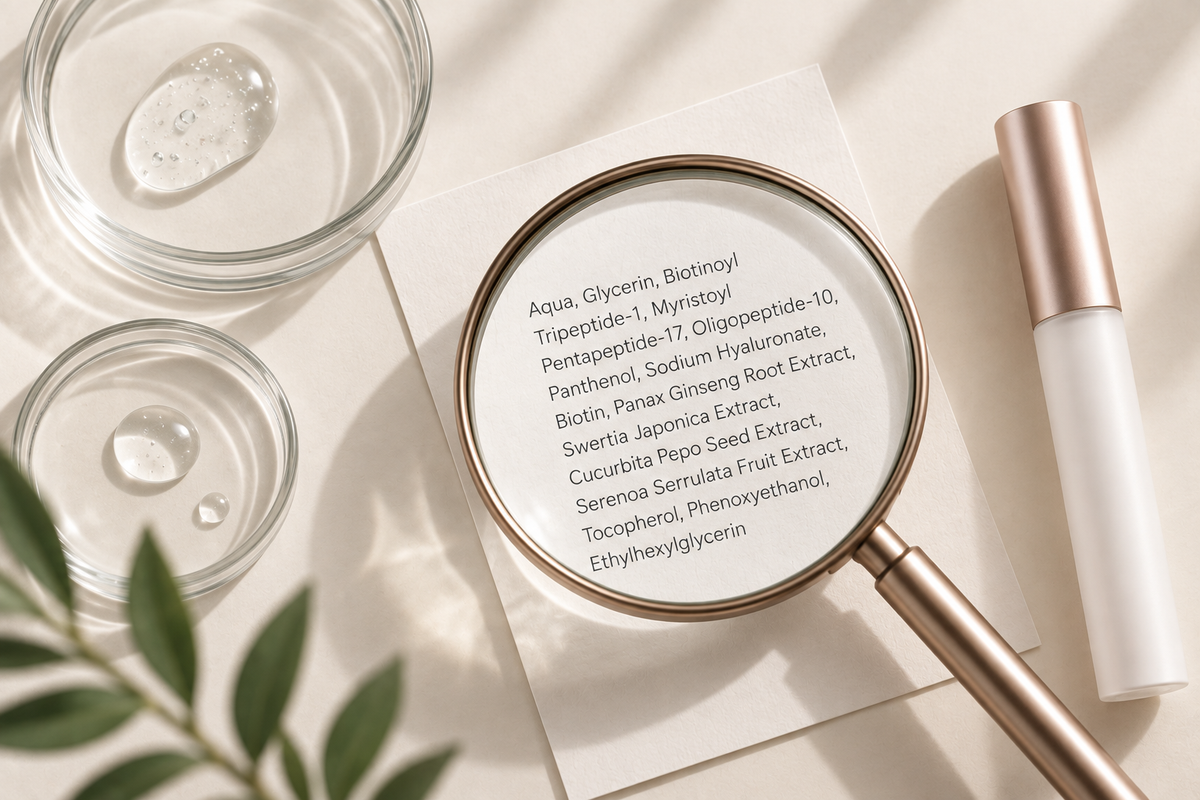
Instead, the formula is built around our proprietary multipeptide complex concentrate with biotin.
It includes three targeted peptides:
Biotinoyl Tripeptide-1
Myristoyl Pentapeptide-17
Oligopeptide-10
Alongside these are ingredients including biotin, panthenol, sodium hyaluronate, vitamin E and selected botanical extracts.
Nuur Lash was deliberately formulated as a prostaglandin-free alternative for people who want to promote natural lash growth without using this ingredient class.
The finished Nuur Lash formula has also undergone ophthalmological testing and has been safety assessed in accordance with UK cosmetic requirements.
How can you tell whether your lash serum contains prostaglandin analogues?
Do not rely entirely on the front of the bottle.
Read the ingredient list.
Some of the prostaglandin-related ingredients that have attracted regulatory attention include Isopropyl Cloprostenate, Methylamido-Dihydro-Noralfaprostal and Dechloro Dihydroxy Difluoro Ethylcloprostenolamide.
Bimatoprost is another important name to recognise because of its established medical use and its documented pigmentation warnings.
If you are unsure what an ingredient is, look it up through a reputable regulatory or medical source rather than relying entirely on social-media claims.
A responsible brand should also be prepared to tell you clearly whether its formula contains prostaglandins or prostaglandin analogues.
Does prostaglandin-free mean a lash serum cannot work?
No.
Prostaglandin-free and prostaglandin-containing lash products represent different formulation approaches.
They should not be assumed to work identically.
Nuur Lash uses a peptide-led, prostaglandin-free formulation designed to promote natural lash growth and support longer, thicker and fuller-looking lashes with consistent once-daily use.
We recommend assessing your individual results after around 12 weeks because eyelashes follow their own natural growth cycle.
Individual results vary.
Choosing a prostaglandin-free serum is therefore not about pretending that prostaglandin medicines have no effect on eyelashes.
They clearly can.
It is about choosing which formulation approach you feel comfortable using repeatedly around your eyes.
What should you do if you notice a change in eye colour?
A genuine change in iris colour should not simply be dismissed as a normal part of using a beauty product.
Stop using the product and seek advice from an appropriate eye-care professional, particularly if the change is accompanied by eye pain, significant redness, visual disturbance or other unusual eye symptoms.
It is also worth taking the product or its full ingredient list with you.
This can help the clinician understand exactly what has been applied.
The same principle applies to persistent irritation from any lash serum.
Cosmetics should never be used to push through significant eye symptoms.
Frequently Asked Questions
Can lash serum permanently change your eye colour?
Bimatoprost and other prostaglandin-type medicines have been associated with increased brown iris pigmentation. The FDA states that iris pigmentation associated with bimatoprost is likely to be permanent.
This does not mean all lash serums cause eye-colour changes.
Which lash serum ingredient can change eye colour?
Bimatoprost is the best documented example.
Other prostaglandin analogues used or proposed for eyelash products have also attracted regulatory safety concerns.
Does Nuur Lash contain bimatoprost?
No.
Nuur Lash contains no bimatoprost, prostaglandins or prostaglandin analogues.
Can a prostaglandin-free lash serum change eye colour?
The recognised prostaglandin-related iris pigmentation mechanism discussed in medical literature and bimatoprost prescribing information does not apply to a formula simply because it is called a lash serum.
What matters is its ingredients.
Prostaglandin-free peptide formulations use a different cosmetic approach.
Is eyelid darkening the same as eye-colour change?
No.
Eyelid darkening affects the skin surrounding the eye.
Iris pigmentation affects the coloured part of the eye itself.
They are different effects and may have different degrees of reversibility.
Are prostaglandins banned from lash serums?
Regulation varies by market.
In February 2026, the European Commission's Scientific Committee on Consumer Safety concluded that the three prostaglandin analogues it assessed could not be considered safe for cosmetic eyelash and eyebrow growth products at the proposed concentrations.
A scientific safety opinion should not automatically be interpreted as meaning every prostaglandin-related ingredient has already been legally banned in every country.
Is Nuur Lash ophthalmologically tested?
Yes.
The finished Nuur Lash formula has undergone ophthalmological testing.
How long should I use Nuur Lash before judging the result?
We recommend approximately 12 weeks of consistent once-daily use before properly assessing your individual result.
One 3 ml bottle is designed to last approximately three months when used as directed.
The Bottom Line
Can lash serum change eye colour?
Certain prostaglandin-type ingredients can be associated with increased iris pigmentation, and bimatoprost carries an official warning that increased brown iris pigmentation may occur and is likely to be permanent.
But the phrase “lash serum” describes a product category, not one universal formula.
Not every serum contains these ingredients.
That is why ingredient transparency matters.
Nuur Lash was deliberately developed without bimatoprost, prostaglandins or prostaglandin analogues.
Instead, it is a pharmacist-formulated, peptide-led lash serum developed in the UK by clinicians and ophthalmologically tested as a finished formula.
When something is being applied millimetres from your eyes every day, understanding what is inside the bottle is worth the extra minute.
About the Author
Esa Badr is a UK Clinical Pharmacist, Independent Prescriber, Clinical Director and Co-Founder of Nuur Cosmetics.
Nuur Cosmetics is a UK clinician-led cosmetics brand focused on thoughtful, high-performance, prostaglandin-free lash and brow care.

Written by Nuur Cosmetics